
Our History
How it all began
As Glasgow’s wealth grew, the city expanded westward, giving rise to what is still known today as The Merchant City.
By the early 1800s, Glasgow was home to numerous informal drinking and luncheon clubs. However, on 5th January 1825, a group of thirty-three distinguished gentlemen, including prominent local businessmen and several Members of Parliament, convened at Walker’s Hotel on Buchanan Street. Their aim was to establish a Glasgow club inspired by the esteemed institutions they had encountered in London and the recently founded New Club in Edinburgh.
A committee was promptly appointed, and at the first general meeting on 21st January 1825, it was decided that the club would be named The Western Club. Membership was capped at 130, with all prospective members elected by ballot. A house situated at the corner of Buchanan Street and St Vincent Street was acquired as the club’s first premises.
By 1837, membership had increased to 300, prompting the need for a larger space. After extended negotiations, the club exchanged its original premises for the Amicable Life Assurance Society building at 147 Buchanan Street. This site, which today houses Apple, was complemented by the purchase of the adjacent building. The newly expanded clubhouse opened in 1842, showcasing a fine example of early Victorian architecture and design.

With membership rising to 600 by 1870, the club expanded into its adjoining St Vincent Street property, adding a large smoking room, library, and committee room in 1872. Further renovations followed in 1905, when the club incorporated the remaining portion of the building. By this time, The Western Club had gained a reputation as an exclusive institution, a status reflected in a Glasgow Evening News article from 20th October 1924, which remarked: “From all accounts, it’s easier to manoeuvre an O.B.E. for yourself than to gain entry as a member of The Western Club.”
The club celebrated its centenary in 1925, marking the first time ladies were permitted to attend a reception at the clubhouse. A grand Centenary Ball at St Andrew’s Hall, attended by 900 guests, was hailed as the season’s most prestigious event.
Growth Through Amalgamation
In 1940, The Western Club absorbed the membership of the Junior Club, founded in 1868. With many of its members serving in World War II, the Junior Club faced financial difficulties, leading to its premises being leased to the Red Cross Society. The merger continued post-war, with the Junior Club officially dissolved in 1952.
Another significant amalgamation occurred in 1958, when The Western Club united with The New Club. Established in 1869, The New Club previously operated from a building at West George Street and Renfield Street. The growing membership necessitated larger premises, leading to the sale of the existing building and a search for a new home
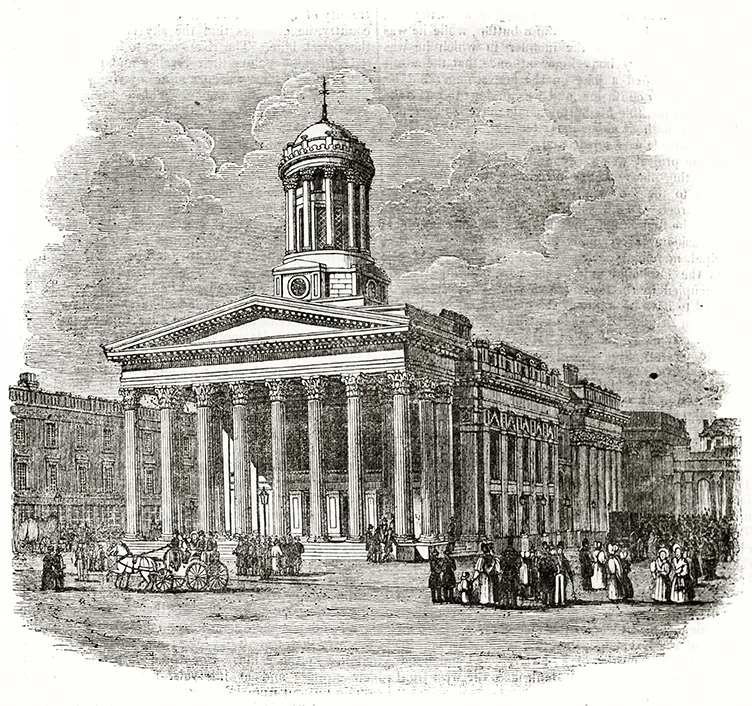
In 1965, The Western Club relocated to its current residence at 32 Royal Exchange Square, a four-story late-Georgian building adapted to meet members’ needs.
A landmark merger took place in 1970 when The Kelvin Ladies’ Club joined forces with The Western Club. Founded in 1897, the Kelvin Club initially met at the North British Railway Hotel on Queen Street before moving to 97 Buchanan Street and later 19 Royal Exchange Square. By 1948, the club boasted 530 members and a waiting list, though numbers had declined to 343 by the time of the merger.
The final amalgamation came in 1991, when The RNVR Club (Scotland) joined The Western Club. Following the sinking of their clubhouse, the SV Carrick, in 1979 and again in 1989, RNVR members were invited to use The Western Club’s facilities, leading to a formal merger.
A Club That Stands The Test Of Time
While many traditional clubs across the UK have struggled, The Western Club has thrived, largely due to its strategic amalgamations. However, by the 1990s, membership had declined, prompting a major refurbishment. To fund the renovations, the club sold one of its notable paintings, Playing Golf at North Berwick by Sir John Lavery, which had been gifted in 1924. The refurbishment was completed in 1998, restoring the club to its former glory and attracting new members.
In January 2000, The Western Club celebrated its 175th anniversary with a gala dinner, followed by a prestigious lunch hosted for HRH The Princess Royal in March 2000.
Today, The Western Club remains a symbol of tradition, excellence, and camaraderie, continuing its proud legacy in the heart of Glasgow.